The exact asset twin — any moment of the mission, in microseconds.
HOLD · mechanicsvalidated vs NASA/JPLK=1012 in 49 µs
A digital twin is only as good as the physics inside it — and in cislunar space the physics is
chaotic by construction. Halos, DROs, near-rectilinear halo orbits: their trajectories diverge
from the first step, so a floating-point twin drifts, and a 15-year mission is millions of thermal
cycles and billions of structural ones past where a simulation decorrelates. The industry's answer
is a private model you re-run to trust and nobody else can audit.
Noether Twin holds the asset as an exact object. Its state at any cycle of the mission
— past or future — is a lookup, not a run; its conservation ledgers hold as algebraic
identities, not tolerances; and the whole thing ships as a certificate a third party re-derives
from the file alone.
A conventional twin is a movie you play forward, drifting from frame one. This twin is an exact
object — any frame, instantly, and provably the asset you certified.
THE TEST Blind, against the cislunar industry's own
reference — NASA/JPL's Three-Body Periodic Orbit Catalog (15,641 Earth–Moon orbits),
with the open-source gold standard (DOP853 adaptive Runge–Kutta) as the parity bar.
THE RESULT Rebuild the orbit, certify its stability,
and get a warrant you can hand a partner, an auditor, or an insurer to check for themselves —
without re-running anything:
Blind parity, at the gold standard. Ten seeded orbits (halo, Lyapunov, DRO), no tuning:
worst stability-index deviation vs JPL 3×10⁻¹¹, orbit closure
2×10⁻⁹, Jacobi drift 5×10⁻¹⁵.
The certificate the industry tools don't produce. A verified spectral bound on each orbit's
monodromy contains the published JPL stability index, 110/110 across the family sweep, with a
falsifiability bracket — and it is 521× cheaper to check than to re-derive.
The mission life, without the mission. The exact state at K=1012 cycles in
49 µs; the resonance envelope transported across 951 configurations at machine precision
(2.6×10⁻¹⁶) where FEM time-integration of the same envelope is
~30,000 years.
Verifiable offline. The warrant re-derives from the file alone — no network, no
apparatus — and a forged claim fails re-derivation. Certification is a state: defined
events revoke it, and a safety limit cannot change quietly.
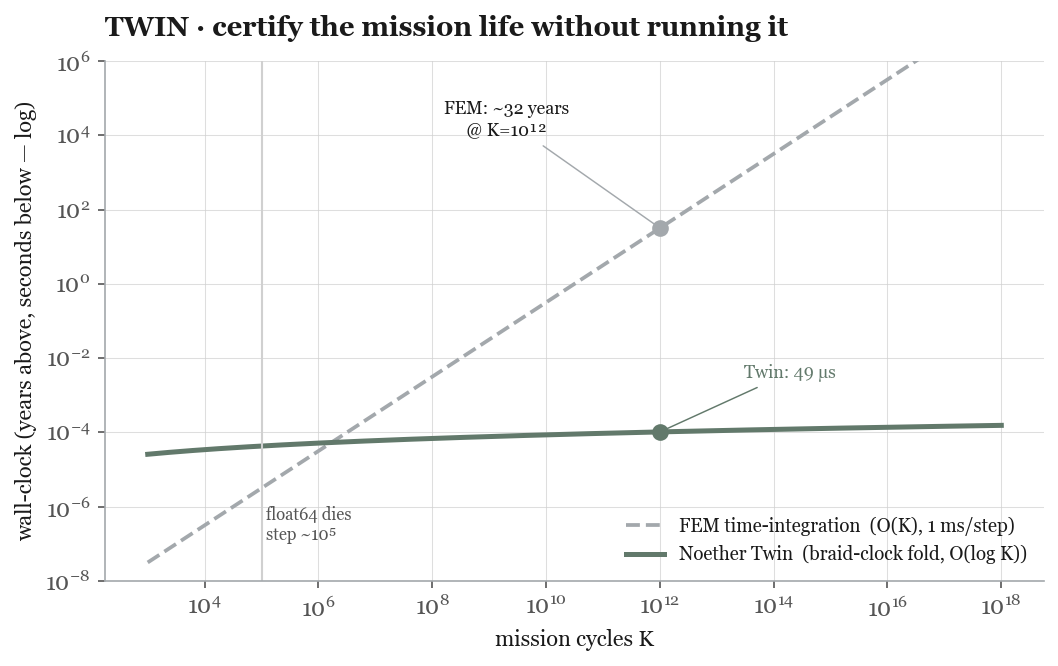
Certify the mission life without running it. Measured anchors (dots) on the scaling laws: FEM
time-integration is O(K) — ~32 years at a decade-mission K=1012, and float64 loses the
clock at step 105; the exact fold is O(log K), holding at microseconds across the whole
axis. Different scaling laws, not a constant factor. FEM cost is a generous 1 ms/step lower bound.
The blind run — against JPL's own catalog
Step
What was measured
The number
The pins
three orbit families fetched live and hashed — halos (the Gateway NRHO family), L1 Lyapunovs, DROs; μ taken from JPL's own system block
15,641 orbits · sha-pinned
Blind parity
10 seeded orbits rebuilt with the open-source integrator, no per-orbit tuning — closure, Jacobi drift, and stability index vs the catalog
worst dev 3.2×10⁻¹¹
The certificate
a verified spectral bound per monodromy; the bound contains the JPL value and refuses just below it
110/110 · both ways
Heat death
the hottest swept orbit's growth exponent at K=1012, evaluated in O(1) where direct integration is ~1017 stages per orbit
certified · unreachable by stepping
The proof
the whole warrant re-derived from the file alone; a forged tighter bound fails on re-derivation
offline · one SHA-256
Twin steel thread & JPL case study — measured audits, blind-seeded, referee = the NASA/JPL Three-Body Periodic Orbit Catalog and DOP853. Demonstration of the capability across the catalog; the asset-specific twin is scoped per engagement.
How — the asset as one exact object
Build from the spec, not the mesh. The asset's coupled periodic channels
— orbit, thermal, structural modes, control loops — are held as one exact register with
closed-form frequencies; no eigensolve, no time-marching. The engine is sealed; its mathematics is
published.
rebuilt to the recorded monodromy, byte-identical
Any cycle is a lookup. The state at cycle K folds in O(log K) —
the whole mission is random-access, exact, at microseconds — so the envelope across every
configuration is transported by an exact scaling law, not re-integrated.
K=1012 · 49 µs · transport dev 2.6×10⁻¹⁶
The books balance as theorems. Energy and load-moment ledgers hold as
exact algebraic identities under any re-steer — conservation that cannot drift, the audit the
certificate rests on.
conservation census exact · 300/300
The answer is a certificate. Every claim re-derives from the file alone,
offline; the certificate carries its own decertification triggers; issuance is mint-locked to a store
only the substrate can produce — and no supercomputer or quantum machine can regenerate without it.
verify · status · mint